
Which Crypto Network Should You Use in Bali? TRC20 vs ERC20 vs BEP20 vs SOL
Sending USDT on the wrong network can quietly drain $20+ per transaction in gas fees. Here's how the four main networks actually compare for crypto-to-cash exchanges in Bali — with the real numbers, not marketing fluff.
Table of Contents
Why Network Choice Matters in Bali
USDT isn't just one thing. It's the same token (Tether), but it lives on multiple blockchains — and each one charges different fees, takes different times to confirm, and plays nicely with different wallets and exchanges.
If you're exchanging USDT to rupiah cash in Bali, the network you choose directly affects three things:
- How much you pay in transfer fees — anywhere from $0.01 to $30+ for the same $1,000 transfer.
- How fast the exchanger confirms receipt — and therefore how soon you hold cash.
- Whether your transaction goes through at all — sending on the wrong network can lock your funds forever.
Real-world example: Sending $1,000 USDT via Ethereum (ERC20) during peak hours can cost $15–$30 in gas fees alone. The same transfer on Tron (TRC20) costs about $0.50. On a busy month with five exchanges, that gap adds up to a Bali villa night — or three scooter rentals.
Quick Comparison: The Four Networks
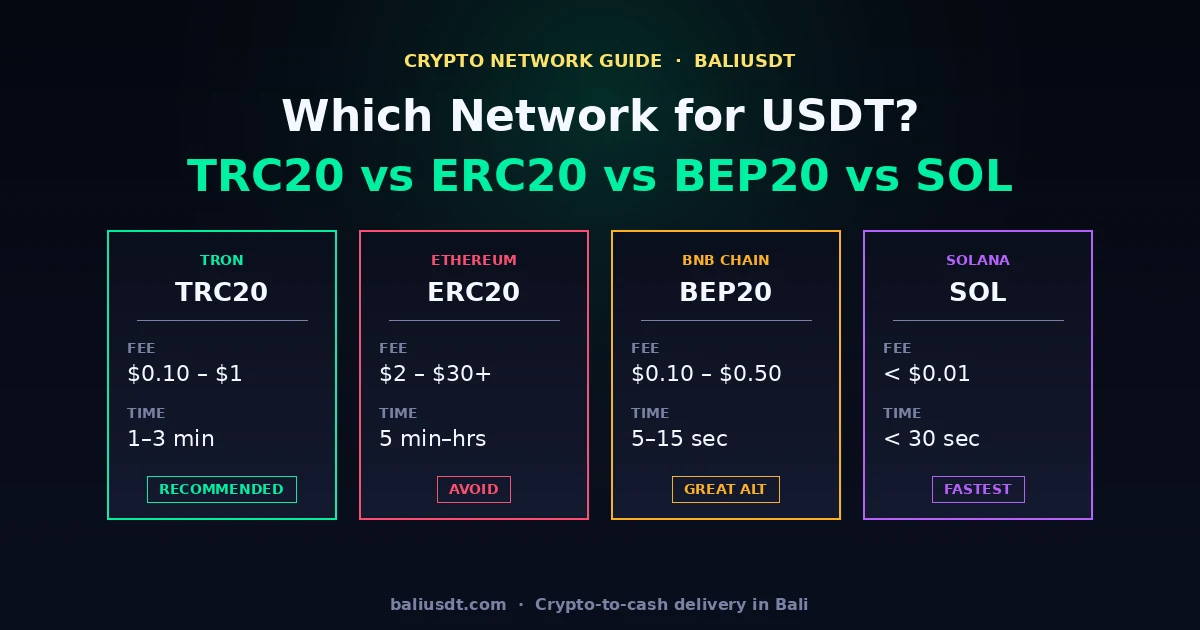
Here's the cheat sheet before we dig into each one. Fees shown are typical for a standard USDT transfer in mid-2026 (fees fluctuate, especially on Ethereum):
TRC20 (Tron)
Fee: $0.10 – $1
Time: 1 – 3 minutes
Default for Bali exchanges. Lowest fees most people can actually use.
ERC20 (Ethereum)
Fee: $2 – $30+
Time: 5 min – several hours
Only use when the recipient doesn't accept anything else.
BEP20 (BNB Smart Chain)
Fee: $0.10 – $0.50
Time: 5 – 15 seconds
Cheap and fast. Great alternative when TRC20 isn't an option.
SOL (Solana)
Fee: < $0.01
Time: Under 30 seconds
Cheapest and fastest, but wallet support is still catching up.
TRC20 (Tron) — The Default Choice
Tron's USDT (often shown as USDT-TRC20 in your wallet) has quietly become the default for peer-to-peer and OTC crypto exchanges across Southeast Asia, and Bali is no different.
Why? Three reasons:
- Stupid-low fees. Most TRC20 transfers cost $0.10–$1, even for large amounts. Tron doesn't have the same congestion issues as Ethereum.
- Fast confirmation. Three minutes is typical. Once you see the confirmation, the agent can release your cash.
- Universal support. Trust Wallet, MetaMask, Binance, OKX, Bybit, Phantom, Ledger — they all handle TRC20. And so does virtually every Bali exchanger.
Downside:Tron isn't as decentralized as Ethereum (it runs on a smaller set of validator nodes), and some crypto purists prefer not to use it for ideological reasons. For practical daily transfers, though, it's hard to beat.
Recommendation for Bali:Unless you have a specific reason to use another network, send USDT via TRC20. BaliUSDT and most other Bali-based exchangers default to TRC20 for this exact reason — it's the cheapest, fastest, and most universally supported option.
ERC20 (Ethereum) — When You Might Use It
Ethereum's USDT (USDT-ERC20) was the original. It's still the most widely supported network globally — every DeFi protocol, every major exchange, every cold wallet works with it.
The catch? Ethereum gas fees.
Gas fees on Ethereum aren't tied to the amount you're sending — they depend on how congested the network is at the moment. On a quiet Sunday morning, you might pay $2–$5 for a transfer. During a busy NFT mint or a meme coin frenzy, that same transfer can hit $30, $50, or even $100.
When ERC20 makes sense:
- The receiving wallet or exchange genuinely doesn't support other networks.
- You're sending a small test amount and want to use the most battle-tested network.
- You're already holding ETH for gas and don't want to acquire TRX or BNB separately.
When to avoid: For any meaningful transfer (over $100), ERC20 is almost always the most expensive option. If your exchanger offers TRC20, BEP20, or SOL — use those instead.
BEP20 (BNB Smart Chain) — The Underrated Alternative
BNB Smart Chain (formerly Binance Smart Chain) hosts USDT as BEP20. It's the sweet spot between Ethereum's compatibility and Tron's low fees.
BEP20 fees typically run $0.10–$0.50 — comparable to TRC20 — and confirmations take 5–15 seconds, which is genuinely fast. The reason it's not the default everywhere is mostly network effect: TRC20 got there first, and people stick with what works.
Practical tip:If you're already using Binance or another CEX that natively supports BNB Chain, BEP20 is a no-brainer. The fees are low, the confirmation is near-instant, and you don't need to bridge or swap networks.
Watch out:BEP20 USDT and BEP2 USDT (the older Binance Chain version) are different things. Most wallets now show BEP20 (also called "BSC") by default. Always confirm which one your recipient wants before sending.
SOL (Solana) — The New Kid on the Block
Solana's USDT (USDT-SPL — Solana uses a different token standard) is the newest of the four. On paper, it wins on every metric: sub-cent fees, sub-30-second confirmation, and a network that handles thousands of transactions per second.
So why isn't everyone using it?
Two reasons: wallet support and adoption. Not every exchange, wallet, or OTC service in Bali has integrated Solana USDT yet. Phantom wallet supports it natively, but Trust Wallet and MetaMask require some setup. And if your Bali exchanger doesn't accept SOL USDT, the cheapest network in the world doesn't help you.
Recommendation:If your exchanger accepts SOL USDT and you already have a Solana-compatible wallet, it's worth considering. The fee savings versus TRC20 are small (fractions of a cent vs. a few dimes), but the speed advantage is noticeable. Just confirm support before you send — sending SPL USDT to a Tron or Ethereum address will result in permanent loss.
Heads up:Solana has had several network outages in past years. While these are becoming rarer, it's worth knowing if you're sending during a high-volatility moment. For most daily transfers in Bali, this isn't a practical concern — but if you're moving a large amount, TRC20 is still the safer bet.
How to Pick the Right Network for Your Bali Exchange
Skip the analysis paralysis. Follow this decision tree:
Ask your exchanger what network they want
BaliUSDT and most reputable Bali crypto services will specify TRC20, BEP20, ERC20, or SOL when giving you a wallet address. This is the single most important step — just use the one they tell you.
Default to TRC20 if you have a choice
If the exchanger accepts multiple networks and doesn't have a preference, use TRC20. Lowest fees in the vast majority of cases, fast confirmation, universal wallet support.
Consider BEP20 if you're already in the BNB ecosystem
If you hold BNB or use Binance heavily, BEP20 is essentially free (you'll pay a few cents in gas) and slightly faster than TRC20.
Use SOL only if both your wallet and the exchanger support it
Great option when fully supported, but the cost savings are marginal vs. TRC20 for most transfer sizes. Don't send SOL USDT to a non-Solana address.
Use ERC20 only as a last resort
If nothing else works and the recipient genuinely requires ERC20, pay the gas fee and move on. For anything above $200, look at bridging through a swap service first.
Common Mistakes That Cost Real Money
Most crypto-to-cash horror stories in Bali come down to one of these:
Sending on the wrong network
USDT on Tron, Ethereum, BSC, and Solana all look the same in your wallet — same logo, same name. The address format is different. Sending USDT-TRC20 to an ERC20 address (or vice versa) will lock your funds. There is no customer support that can recover them. Triple-check before confirming.
Paying $20+ in gas for a $500 transfer
This happens when people default to ERC20 without checking. On a slow day it's $5; on a busy day, it's $30+. Always check live gas fees on etherscan.io/gastracker before sending via Ethereum.
Forgetting the memo/tag (for some exchanges)
Some centralized exchanges require a memo or destination tag for certain networks. Forget it and your funds land in the exchange's main pool, not your account. Recovery is slow and sometimes impossible.
Sending from an exchange that doesn't support withdrawals on the right network
Some exchanges only let you withdraw USDT on specific networks. If your wallet only holds ERC20 USDT but the Bali exchanger wants TRC20, you'll need to swap networks first — usually through a small bridge or a withdrawal back to your own wallet.
Not verifying the address character-by-character
Clipboard malware is a real thing. Some clipboard hijackers silently replace a copied crypto address with the attacker's. Always check the first 4 and last 4 characters of the pasted address against what your exchanger sent you.
Good news:When you use a verified exchanger like BaliUSDT, most of these mistakes are easy to avoid. The agent sends you a wallet address with the network clearly labeled, waits for your confirmation, and verifies on-chain receipt before the transaction is considered complete. It's a much safer workflow than trying to coordinate a P2P swap with a stranger on Telegram.
Frequently Asked Questions
What's the cheapest network to send USDT in 2026?
Tron (TRC20) is still the cheapest for most users, with fees typically under $1. Solana (SOL) is technically even cheaper (fractions of a cent) but support is more limited. BEP20 on BNB Smart Chain is also a strong contender at $0.10–$0.50 per transfer.
Can I send USDT TRC20 to an ERC20 address by mistake?
Yes, and if you do, your funds will likely be lost permanently. Always triple-check that the receiving address supports the network you're sending on. BaliUSDT and other verified exchanges will specify the exact network when providing a wallet address.
Why does Ethereum (ERC20) charge so much for USDT?
Ethereum gas fees depend on network congestion and the complexity of the transaction. During peak times, fees can spike to $30+ per transfer. ERC20 USDT is popular because Ethereum is the most widely supported network, but for pure cost savings, TRC20 or BEP20 are better choices.
Is Solana USDT safe to use in Bali?
Solana's USDT (often shown as USDT-SPL) is safe and processed by Tether officially. However, not all exchanges and wallets support it yet, so confirm with your recipient before sending. Once supported, it's arguably the best option for speed and cost.
Which network do most crypto exchanges in Bali accept?
Most OTC exchangers and crypto-to-cash services in Bali accept TRC20 as the default, with many also supporting ERC20, BEP20, and Solana. TRC20 remains the most popular because of its low fees and fast confirmation — typically under 3 minutes.
How long does each network take to confirm?
Tron (TRC20): 1–3 minutes. BNB Smart Chain (BEP20): 5–15 seconds. Solana (SOL): under 30 seconds. Ethereum (ERC20): 5 minutes to several hours during congestion. For Bali exchanges where you want cash fast, TRC20 strikes the best balance.
Ready to Exchange USDT to Cash in Bali?
Send USDT on TRC20, BEP20, ERC20, or SOL — BaliUSDT accepts all major networks and delivers cash to your villa, hotel, or coworking space anywhere on the island.
Exchange Now on WhatsAppOperating hours: 08:00 – 22:00 WITA, 7 days a week